Drama is a genre of literature and a performing art form that consists of stories with conflict, emotions, and dialogue that are created to be performed by actors on a stage, radio, or screen. It uses story, characters, theme, and audience participation to generate meaning and tension. The word, which has Greek roots and means “to do” or “to act”, refers to a variety of human experiences that range from comedy to tragedy.
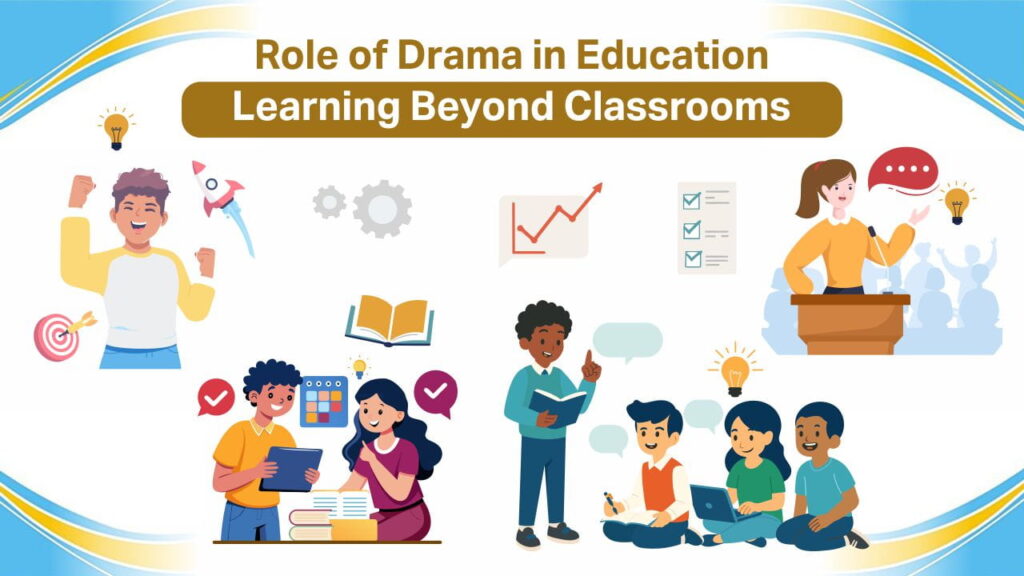
The role of drama in education is essential to contemporary education because it transcends typical classroom instruction and makes learning come to life. Drama’s educational value is found in its capacity to actively involve students, assisting them in comprehending ideas via movement, expression, and real-world scenarios. It fosters creativity, communication, and critical thinking rather than just memorisation, which makes learning more relevant and pleasurable for kids.
Here, we will talk about how drama plays an important role in education. 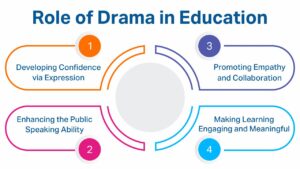
Role of Drama in Education
- Developing Confidence via Expression
- Enhancing the Public Speaking Ability
- Promoting Empathy and Collaboration
- Making Learning Engaging and Meaningful
Role of Drama in Education
Developing Confidence via Expression
Drama provides people a stage on which they can express themselves truthfully and artistically. Participants learn more about themselves and become more confident in their own distinct voice and viewpoint by investigating various personalities, feelings, and circumstances. Whether it’s in a play, improvisation exercise, or drama class, taking part in theatrical activities entails performing in front of people. In order to successfully communicate emotions and messages, drama activities generally require training and honing body language, gestures, and facial expressions. Gaining confidence in social situations and public speaking may be achieved by honing these nonverbal communication abilities.
Enhancing the Public Speaking Ability
Drama practice is one of the main ways theatre lessons improve public speaking abilities. In front of an audience, students are encouraged to adopt different roles and perform dialogues, scenes, and monologues. They learn how to captivate and engage their audience via this experience, which also helps them feel more at ease speaking in front of an audience. They develop control over their body language, facial expressions, and voice tone as they practise their performances—all of which are essential elements of successful communication. Students improve their abilities and boost their self-confidence in their capacity to speak well by getting helpful criticism from teachers and peers.
Promoting Empathy and Collaboration
The ability to comprehend and experience another person’s emotions is known as empathy. By assuming the roles of different people, drama offers kids a special chance to hone this ability. Children must take into account the feelings and intentions of the characters they play, whether they are acting out situations with classmates or portraying a part in a play.
Children have a greater comprehension of the feelings and viewpoints of others via this exercise, which is essential for developing empathy. They learn to place themselves in other people’s shoes and see the world from their perspective as they play out events. This educates kids to be more sympathetic and perceptive in interpersonal relationships and aids in their recognition of the complexity of human emotions.
They learn how to effectively communicate thoughts, feelings, and information with their bodily actions and voices via theatre. They also learn the value of attentive listening, which is an essential component of successful communication. They develop their capacity for collaboration by participating in group activities or performances, which enhances their social skills.
Making Learning Engaging and Meaningful
Drama transforms the learning process into an engaging and meaningful experience. When students enact complex ideas, historical events, or moral lessons, abstract concepts become easier to understand and relate to. Active participation through role-play, storytelling, and performances helps learners connect emotionally with the subject, leading to deeper comprehension and long-term retention.
This hands-on, experiential approach strengthens memory, as students learn by doing rather than by rote memorisation. Drama also creates a joyful and stress-free learning environment, encouraging curiosity and enthusiasm in the classroom. By making lessons interactive and lively, drama not only enhances academic performance but also fosters a genuine love for learning that stays with students beyond textbooks.
All of these points show that, other than education, the role of drama in personality development is also of immense significance.
Why Leading CBSE Schools in Lucknow Emphasise Drama
Leading CBSE schools in Lucknow recognise the important role of drama in education. This is because drama-based learning also aligns well with the CBSE curriculum’s focus on experiential and activity-oriented education. It encourages critical thinking, problem-solving, and empathy by allowing students in these schools in Lucknow to explore real-life situations and diverse perspectives.
K.R. Mangalam World School: Nurturing Talent Through Drama
K.R. Mangalam World School is one of the best CBSE schools in Lucknow. It understands the role of drama in education and personality development. That is why drama and performing arts form an integral part of student development at K.R. Manglam World School. Through structured drama activities, theatre sessions, and creative performances, students are given opportunities to enhance their communication skills, emotional expression, and imagination. These experiences help learners discover their strengths while developing discipline and teamwork.
Conclusion
The role of drama in education extends far beyond entertainment, playing a vital part in shaping confident, creative, and emotionally intelligent learners. By making learning interactive and meaningful, drama supports academic understanding while contributing significantly to personality development. Leading CBSE schools in Lucknow, such as K.R. Mangalam World School, recognise the value of drama in nurturing communication skills, leadership qualities, and self-expression. Choosing schools that integrate drama into their curriculum ensures a balanced education that prepares students for both academic success and real-life challenges.
FAQs
Q1. What is the role of drama in education?
Drama enhances learning by making lessons interactive, improving understanding, retention, and student engagement while developing communication and creative skills.
Q2. How does drama support personality development in students?
Drama helps students build confidence, emotional intelligence, teamwork, leadership skills, and the ability to express themselves effectively.
Q3. Is drama important in CBSE schools?
Yes, drama aligns with the CBSE curriculum’s focus on experiential and holistic learning, supporting both scholastic and co-scholastic development.
Q4. Why do CBSE schools in Lucknow focus on drama education?
Many CBSE schools in Lucknow emphasise drama to ensure all-round student development, balancing academics with creativity, confidence, and life skills.
Q5. How does K.R. Manglam World School promote drama among students?
K.R. Manglam World School integrates drama through performances, workshops, and cultural activities, helping students develop creativity, confidence, and leadership abilities.