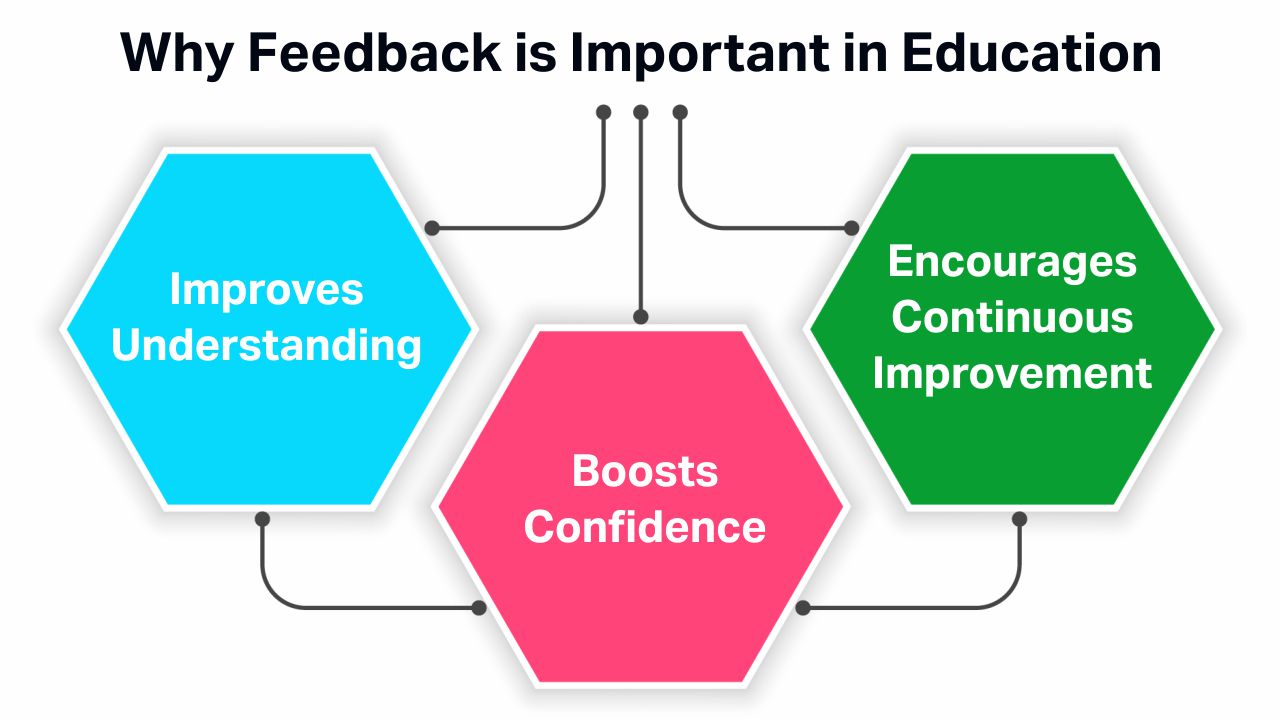
Feedback is essential to education since it shapes the learning experiences of students and helps them succeed academically. It is a valuable tool that can significantly enhance learning. Students who receive timely and helpful feedback are better able to recognise their strengths. They are able to pinpoint areas for growth and develop conceptual clarity. Additionally, it enhances self-esteem, promotes introspection, and inspires students to do better. Feedback promotes both academic progress and general personality development by encouraging ongoing development and open communication. This blog post will discuss why feedback is important in education.
The Function of Feedback in Education
The first step towards understanding why feedback is important in education is to understand its function.
A vital line of contact between teachers and students is feedback. It gives students performance insights, enabling them to discover their areas of strength and growth. Students are encouraged to evaluate their work and make any required corrections. This promotes an ongoing cycle of learning and growth.
Feedback provides educators with reliable information about how well their teaching strategies are working. It enables teachers to determine if students are responding well to their teaching methods or whether changes are required.
Kinds of Feedback
Feedback in education can take many different forms, each with a specific function. So another way to know why feedback is important in education is to get clarity about its different kinds:
- Formative Feedback: Continuous feedback given during the learning process is known as formative feedback. Its goal is to assist students in getting better before final exams. Comments on a draft essay, for instance, help students improve their work before turning it in.
- Summative Feedback: This kind of feedback is provided following the completion of a task and typically takes the form of concluding remarks or grades. It assesses overall performance and gives students a sense of where they are in relation to their academic objectives.
- Descriptive Feedback: It focuses on specific elements of a student’s work. It gives students a clear understanding of their strengths and areas for improvement.
- Evaluative feedback: It summarises the calibre of the student’s work and is frequently expressed in the form of marks or scores. It could not always offer the specific insights required for change, even if it is crucial for final judgments.
The Effect of Student Motivation on Feedback
To comprehend why feedback is important in education, it is essential to know its effect. One of the most effective motivators in school is feedback. Giving students positive comments can increase their self-esteem. This also motivates them to take on more difficult assignments. On the other hand, when provided carefully, constructive criticism can inspire pupils to work harder to address their shortcomings.
Students are more likely to actively interact with the course material, ask questions, and seek clarification when they receive feedback on a consistent basis. Deeper comprehension and long-term information retention depend on this interaction.
Feedback as an Instrument for Personalised Education
The next aspect we’ll discuss in this why feedback is important in education blog is the feedback’s crucial advantage, i.e. its capacity to facilitate personalised learning. Each kid has different learning preferences and speeds. Feedback enables teachers to modify their lessons to fit each student’s unique requirements.
In a similar vein, based on the feedback they get, students who perform very well in particular topics may be offered options for advanced learning. This fosters their enthusiasm for studying while also challenging them intellectually.
So, the above-mentioned information showed why feedback is important in education.
Technology’s Contribution to Improving Feedback
In the current digital era, technology has completely changed how feedback is given in the classroom. Real-time feedback is made possible via online platforms, allowing pupils to improve right away. Digital technologies may also monitor students’ development over time, giving teachers and students data-driven insights into learning outcomes.
Peer review is another way that technology helps students evaluate and comment on one another’s work. In addition to improving learning, this cooperative method develops communication and critical thinking abilities.
Top 10 Schools in Lucknow
Below are the top schools in Lucknow that also use feedback-oriented learning:
- K.R. Mangalam World School (KRMWS)
- City Montessori School (CMS)
- Delhi Public School (DPS)
- GD Goenka Public School
- Ryan International School
- Amity International School
- Seth M.R. Jaipuria School
- La Martiniere College
- St. Francis’ College
- DPS Gomti Nagar
KRMWS
A known CBSE board school in Lucknow, KRMWS, follows a student-centric approach where constructive feedback is an integral part of learning. Teachers provide timely, clear, and actionable feedback that helps students recognise their strengths, improve weaknesses, and stay motivated. This continuous guidance supports academic progress, confidence building, and overall development.
Conclusion
To sum this why feedback is important in education blog, we can conclude that feedback is essential in shaping effective learning experiences and student success. When used constructively, it encourages improvement, self-reflection, and confidence. Top board schools in Lucknow, such as KRMWS, stand out for creating feedback-driven learning environments that nurture well-rounded and future-ready learners.
FAQs
Q1. Why is feedback important in education?
Feedback helps students understand their performance, improve learning outcomes, and stay motivated.
Q2. How does feedback support student growth?
It identifies strengths and areas for improvement, encouraging continuous learning and confidence.
Q3. Is feedback important in CBSE board schools?
Yes, CBSE emphasises formative assessment and feedback to support competency-based learning.
Q4. How does KRMWS implement feedback in classrooms?
KRMWS integrates regular assessments, personalised teacher guidance, and constructive feedback into daily learning.