
Young children naturally try to solve problems. When they encounter something like a loose screw or a situation that isn’t clear, they instinctively start exploring options and figuring out what to do. We must acknowledge this inclination as a strength. Learning now encompasses more than just figuring out the correct answer; it also involves how students approach a problem, what they notice, and how they react when something doesn’t work the first time. This is where design thinking in schools comes into the picture.
It provides a simple, repeatable method for comprehending an issue, weighing solutions, and testing concepts in real-world settings. Students take their time, observe, and listen rather than jumping to conclusions. They get an understanding of their target audience, what matters most in a certain situation, and how concepts change when put to the test in real life.
This kind of thinking gradually increases confidence. Students learn to understand that uncertainty is a beginning point rather than a barrier.
In this blog, more about design thinking in schools will be explored.
What is Design Thinking?
Before talking about design thinking in schools, it is crucial to know its meaning. It is an iterative, non-linear, human-centred method of creative problem-solving. Understanding user requirements, questioning presumptions, and reframing challenges are the main goals of design thinking.
Key Five Stages of Design Thinking
Before discussing the importance of design thinking in schools, it is important to comprehend the five stages of design thinking. Students are encouraged to think more deeply and pay more attention at each level.
Empathise
Students begin by understanding people and situations. They observe, talk, listen, and ask questions. They also try to see things from different perspectives, which gives everything that follows a clear sense of purpose.
Students who cultivate empathy are better able to relate to real-world issues both intellectually and emotionally. Compassion, awareness, and a deeper understanding are developed at this level and serve as the cornerstones of significant solutions.
Define
Students determine what truly requires attention from all of the observations. Instead of addressing everything at once, they make the problem clearer. A clearly defined challenge gives the work ahead direction, focus, and purpose.
This phase promotes clarity and logical thinking. Students gain the ability to prioritise important issues, organise their thoughts, and formulate a clear problem statement that directs their creative endeavours.
Ideate
Students freely explore concepts with a specific goal in mind. Their open-minded thinking allows their imagination to respond to what they have seen and heard.
Brainstorming sessions promote free thinking without worrying about criticism. Students develop collaboration and creativity by working together, building on each other’s ideas, and exploring new possibilities.
Prototype
Thoughts manifest themselves. A basic mock-up, storyboard, model, or sketch can help translate an idea into action. As pupils attempt to apply their concepts in the actual world, skills start to develop organically.
At this point, experiential learning is encouraged. Through experimentation and the creation of concrete models, students gain resilience, practical skills, and the confidence to turn abstract concepts into feasible solutions.
Test
Students test out their creations. They observe what functions well, what doesn’t, and why. Feedback becomes a component of learning, assisting them in improving their strategy and way of thinking.
Testing promotes introspection and flexibility. As they refine their solutions for better results, students learn to accept constructive criticism and realise that progress is a continuous process.
Importance of Design Thinking in Schools
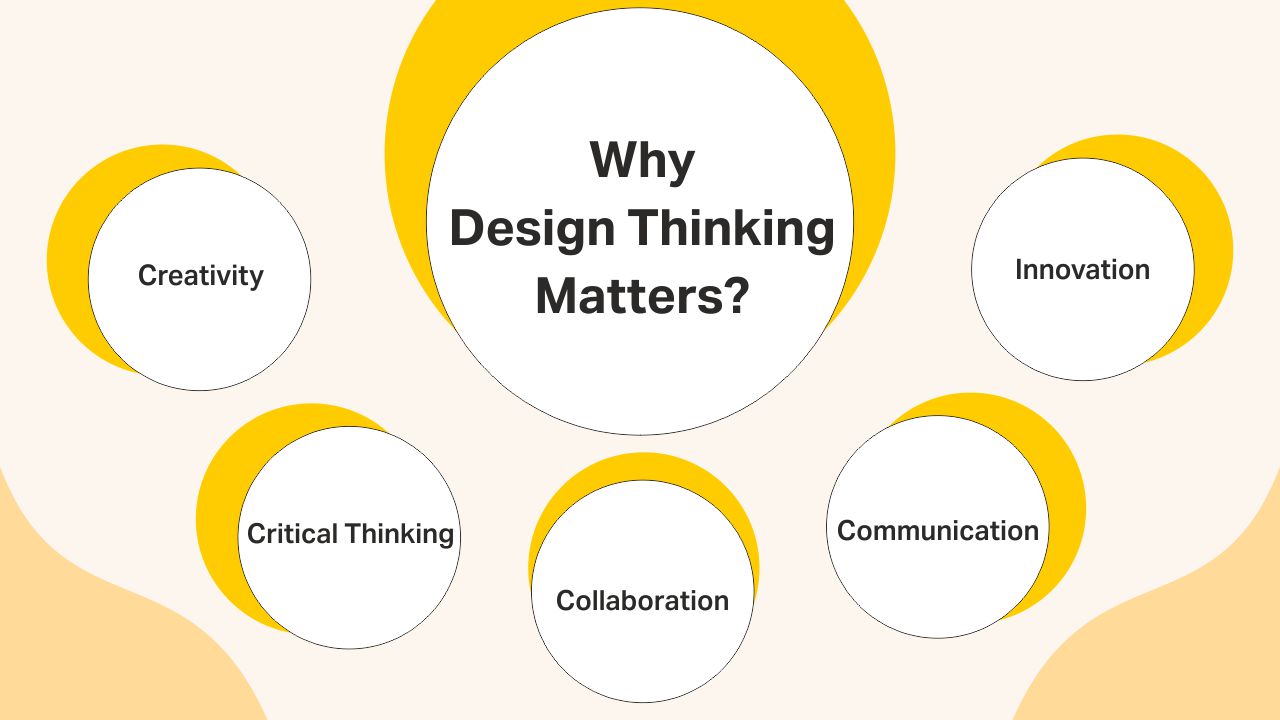
Now it’s time to talk about the importance of design thinking in schools.
Teaches Empathy and Purpose
Students gain awareness of the people, circumstances, and difficulties in their environment. This sense of purpose guides their decisions and gives meaning to what they create.
Enhances the Ability to Think Through Actions
Students assess information, consider options, and make thoughtful decisions as they work to meet real needs. Skills develop as a result of making ideas practical, rather than being an end in themselves.
Encourages Cooperation and Communication
Teams are involved in the majority of design-thinking work. Students listen intently, clarify concepts, and resolve disagreements. They get to know what it’s like to work together to create something for a common goal.
Promotes All-Encompassing Education
Science, art, technology, the humanities, and daily life are all connected by design thinking. Instead of being separated by disciplines, learning seems connected by meaning.
Role of Schools in Lucknow in Promoting Design Thinking
Many schools in Lucknow, like K.R. Mangalam World School, are increasingly adopting design thinking practices to prepare students for real-world challenges. By integrating experiential and project-based learning into the curriculum, students move beyond textbooks and engage in practical problem-solving activities.
Leading CBSE schools in Lucknow encourage inquiry-based classroom discussions where students are free to question, explore, and analyse different perspectives. Innovation labs and activity-based assignments further support hands-on learning, allowing students to experiment, create, and refine their ideas.
Moreover, top schools in Lucknow place strong emphasis on communication and presentation skills, ensuring that students not only develop innovative solutions but also confidently express and defend their ideas. This holistic approach nurtures creative, analytical, and confident learners.
KRMWS: Encouraging Design Thinking in Schools
KRMWS integrates design thinking into its academic framework by promoting experiential learning, collaborative projects, and innovation-driven activities. As a progressive CBSE institution, it nurtures creativity, problem-solving, and confidence among students. By focusing on holistic development, KRMWS has indeed become the best school in Lucknow among many.
Conclusion
Design Thinking in Schools empowers students to become creative problem-solvers, critical thinkers, and confident communicators. By encouraging empathy, innovation, and practical application, schools help learners develop skills that go beyond academics. Many schools in Lucknow, like KRMWS, are embracing this approach to prepare students for future challenges through experiential and inquiry-based learning.
Choose a KRMWS, as it inspires young minds every day.
FAQs
Q1. What is Design Thinking in Schools?
Design Thinking in Schools is a structured, student-centred approach that encourages empathy, problem-solving, creativity, and innovation through five key stages.
Q2. What are the Five Stages of Design Thinking?
Empathise, Define, Ideate, Prototype, and Test.
Q3. Why is Design Thinking important for students?
It builds critical thinking, collaboration, communication skills, and real-world problem-solving abilities.
Q4. How do schools in Lucknow promote Design Thinking?
Many schools in Lucknow integrate project-based learning, innovation labs, and inquiry-driven discussions into their curriculum.